
-->
Many misconceptions about ODBC exist in the computing world. To the end user, it is an icon in the Microsoft® Windows® Control Panel. To the application programmer, it is a library containing data access routines. To many others, it is the answer to all database access problems ever imagined.
First and foremost, ODBC is a specification for a database API. This API is independent of any one DBMS or operating system; although this manual uses C, the ODBC API is language-independent. The ODBC API is based on the CLI specifications from Open Group and ISO/IEC. ODBC 3.x fully implements both of these specifications - earlier versions of ODBC were based on preliminary versions of these specifications but did not fully implement them - and adds features commonly needed by developers of screen-based database applications, such as scrollable cursors.
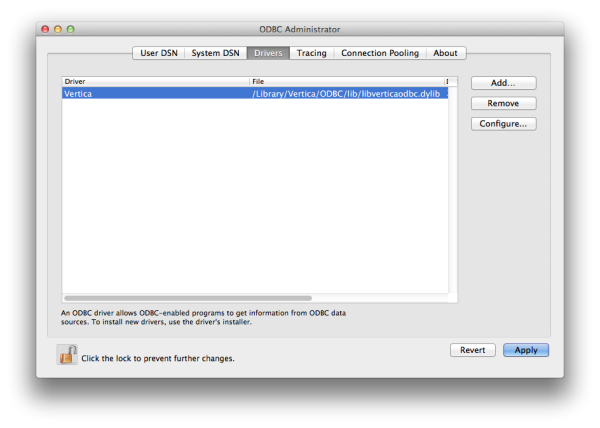
On macOS, the ODBC Administrator, based on the iODBC manager, provides easy administration of ODBC drivers and configuration, allowing the updates of the underlying iODBC configuration files through a GUI tool. 7third grade james tes.
- IODBC Driver Manager - The Driver Manager is implemented as a Framework under Mac OS X; and a Shared Library under Darwin, Linux, UNIX and OpenVMS. IODBC Administrator - iODBC provides the native.
- ODBC Driver: ODBC Data Source Administration Tool (Windows) ODBC Manager (macOS) iODBC or unixODBC (Linux).NET Driver: NuGet Package Manager; Applies To SnowSQL / Snowflake Python Connector / Snowflake Spark Connector / Snowflake Kafka Spark Connector / Snowflake JDBC Driver / Snowflake OBDC Driver / Snowflake Node.JS Drivr / Snowflake Go.
- IODBC SDK - Used by developers for the development of ODBC-compliant database applications and drivers, the iODBC SDK includes all necessary Header Files and Shared and Static Link Libraries, as.
Iodbc Driver Manager Administrator Sdk Software
The functions in the ODBC API are implemented by developers of DBMS-specific drivers. Applications call the functions in these drivers to access data in a DBMS-independent manner. A Driver Manager manages communication between applications and drivers.
Although Microsoft provides a driver manager for computers running Microsoft Windows® 95 and later, has written several ODBC drivers, and calls ODBC functions from some of its applications, anyone can write ODBC applications and drivers. In fact, the vast majority of ODBC applications and drivers available today are written by companies other than Microsoft. Furthermore, ODBC drivers and applications exist on the Macintosh® and a variety of UNIX platforms.
To help application and driver developers, Microsoft offers an ODBC Software Development Kit (SDK) for computers running Windows 95 and later that provides the driver manager, installer DLL, test tools, and sample applications. Microsoft has teamed with Visigenic Software to port these SDKs to the Macintosh and a variety of UNIX platforms.
It is important to understand that ODBC is designed to expose database capabilities, not supplement them. Thus, application writers should not expect that using ODBC will suddenly transform a simple database into a fully featured relational database engine. Nor are driver writers expected to implement functionality not found in the underlying database. An exception to this is that developers who write drivers that directly access file data (such as data in an Xbase file) are required to write a database engine that supports at least minimal SQL functionality. Another exception is that the ODBC component of the Windows SDK, formerly included in the Microsoft Data Access Components (MDAC) SDK, provides a cursor library that simulates scrollable cursors for drivers that implement a certain level of functionality.
Applications that use ODBC are responsible for any cross-database functionality. For example, ODBC is not a heterogeneous join engine, nor is it a distributed transaction processor. However, because it is DBMS-independent, it can be used to build such cross-database tools.
The sdkmanager is a command line tool that allows you to view, install,update, and uninstall packages for the Android SDK. If you're using AndroidStudio, then you do not need to use this tool and you can instead manage yourSDK packages from the IDE.
The sdkmanager tool is provided in the Android SDK Tools package(25.2.3 and higher) and is located inandroid_sdk/tools/bin/.
Usage
You can use the sdkmanager to perform the following tasks.
List installed and available packages
Use the channel option to include a package from a channel up to andincludingchannel_id. For example, specify the canary channel to list packagesfrom all channels.
--channel=0 or remove the --channeloption entirely.
Install packages
The packages argument is an SDK-style path as shown withthe --list command, wrapped in quotes (for example,'build-tools;29.0.2' or'platforms;android-28'). You can pass multiple packagepaths, separated with a space, but they must each be wrapped in their own set ofquotes.
For example, here's how to install the latest platform tools (which includesadb and fastboot) and the SDK tools for API level 28:

Alternatively, you can pass a text file that specifies all packages: Fight night round 3 (usa) iso download links.
The package_file argument is the location of a text file in whicheach line is an SDK-style path of a package to install (without quotes).
To uninstall, simply add the --uninstall flag:
To install CMake or the NDK, use the following syntax:
For example, use the following command to install the specified NDK version regardlessof which channel it is currently on.
Update all installed packages
Options
The following table lists the available options for the above commands.
Iodbc Driver Manager Administrator Sdk Download
| Option | Description |
|---|---|
--sdk_root=path | Use the specified SDK path instead of the SDK containing this tool |
--channel=channel_id | Include packages in channels up to and including channel_id. Available channels are: How to check for virus on mac. |
--include_obsolete | Include obsolete packages in the package listing or package updates. For use with --list and --update only. |
--no_https | Force all connections to use HTTP rather than HTTPS. |
--verbose | Verbose output mode. Errors, warnings and informational messages are printed. |
--proxy={http | socks} | Connect via a proxy of the given type: either http for high level protocols such as HTTP or FTP, or socks for a SOCKS (V4 or V5) proxy. |
--proxy_host={IP_address | DNS_address} | IP or DNS address of the proxy to use. |
--proxy_port=port_number | Proxy port number to connect to. |
REPO_OS_OVERRIDEenvironment variable to either 'windows', 'macosx', or 'linux'.